- Alberto Thirion
- View Portfolio
- Image 1 of 41
- Added 19 hours ago
- 17 Views
- Share This Image On...
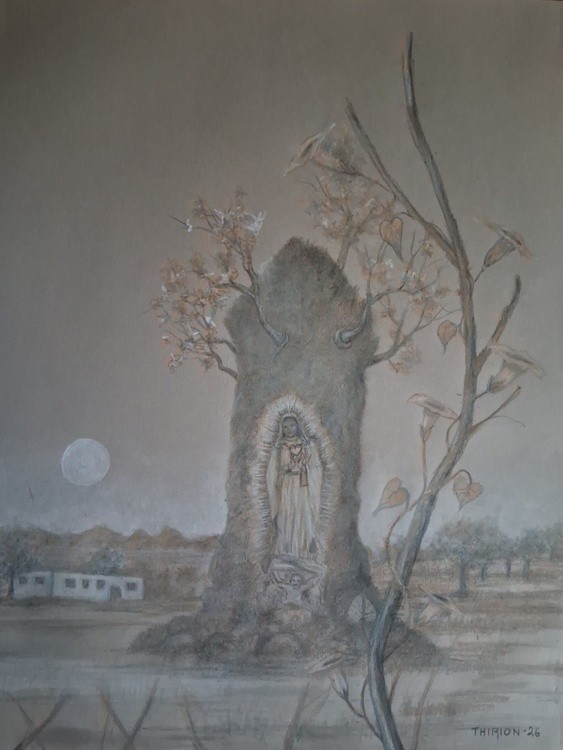
The Silent Emergence on the Wounded Plain In the desolate expanse where oblivion casts its mantle of ash and cold, stands a tragic, hollow trunk, battered by the axe of time. Yet from its heart, wounded by pain, a miracle sprang forth against the bleak, parched wasteland—which, in its silent summer, guards a sanctuary that remained unconquered. The sacred architecture emerges— born of the light within the dead bark— unmoved by the dark of night. And ivy, waking shyly, weaves an altar of mystical tenderness, leaving hope open to the heavens. Why does contemporary art fear the sacred? We live in an era obsessed with noise, immediacy, and profound superficiality. The contemporary art market has turned into a runway for cheap provocations and hollow concepts that require three pages of theoretical justification just to stand up. Cynicism is rewarded, while introspection is punished. That is why, when I present a work like *The Silent Apparition on the Wounded Plain*, I know full well that I am committing an act of absolute rebellion against the modern canon. What constitutes true provocation today? It is not the inverted urinal or the banana taped to the wall; true transgression lies in daring to gaze upon the sacred in a world that insists on profaning everything. In this painting, I confront the contradiction head-on, without anesthesia. It depicts a devastated plain—a rural landscape scarred by time, oblivion, and the pale gaze of a spectral moon. Any docile artist in today’s art circuit would have painted nothing but decay—the nihilism they love to sell. Yet my brush refuses to surrender to the void. From the center of that withered trunk—dead on the outside—emerges the imperturbable silhouette of the Virgin of Guadalupe, embraced by a vine that insists on blooming. This is the contradiction that defines my work and, if I may say so, my own existence: the constant tension between the heaviness of our earthly reality—riddled with scars—and the unshakeable mystical force that refuses to die. Art does not need the grand stone temples of institutions or the stamp of approval from trendy critics to manifest its greatness; the complicity of nature and the honesty of a single brushstroke are enough. Faith, like true art, does not survive in the sterilized museums of great capitals, but here: on the wounded plain, springing from the absent wood in absolute and defiant silence. Let the skeptics be scandalized; those who still know how to see will understand.
Post a New Image Comment